
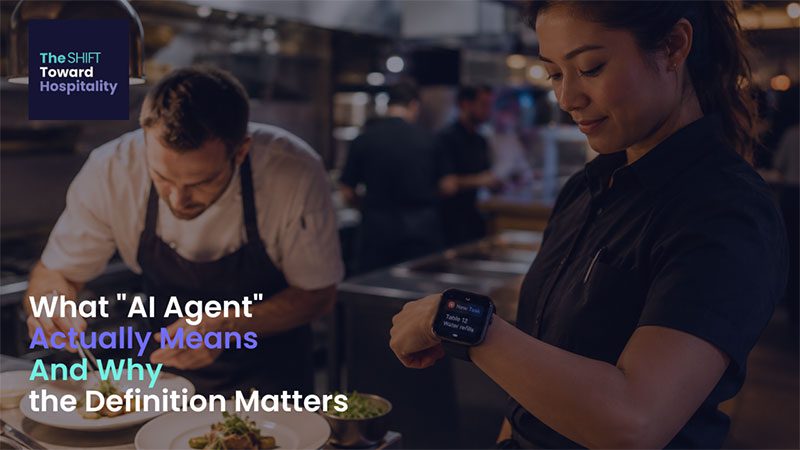
Last week at HITEC, Harikrishna Patel said something that needed to be said out loud. The term “AI Agent” is everywhere right now. And the industry hasn’t agreed on what it means yet.
That ambiguity has real consequences. Not because vendors are acting in bad faith but because buyers are making decisions without a shared definition, and the gap between what’s being promised and what’s being built is widening.
It’s worth establishing some clarity: a chatbot with a new name isn’t an agent. A dashboard that answers questions isn’t an agent. A feature set that surfaces insights and stops there isn’t an agent. It’s a dressed-up report. A useful one, maybe. But not the same thing.
What an Agent Actually Does
Hari’s framework is the right one. A real agent plans, acts, and decides.
It takes an outcome and works backwards. It executes across systems without waiting to be prompted at each step. It makes the call, not just the chart.
That distinction matters more than it sounds. Most hospitality technology today is still built around the assumption that a human will complete the loop. The system surfaces the information. The manager interprets it. The manager acts. The technology’s job ends at insight.
That’s not agency. That’s a smarter inbox.
The Real Problem
The hospitality industry has spent a decade collecting data and not enough time acting on it.
Operators are not short on information. They are short on time, bandwidth, and the organizational capacity to turn what they know into what they do. Labor data lives in one system. Sales data lives in another. Guest behavior lives in a third. Someone still has to synthesize it all and make a decision — usually under pressure, usually in a narrow window.
A real agent closes that gap. It doesn’t hand the operator a cleaner dashboard and call it intelligence. It holds context across systems, identifies the moment that requires action, draws on all the data the operation has, and executes. Or at minimum, executes the first three steps and escalates only what genuinely needs a human.
That’s the difference between AI that reduces noise and AI that produces outcomes.
What’s Changing
The conversation at HITEC wasn’t really about technology. It was about expectations.
When a product is called an AI agent, it carries an implicit promise: this system will act on your behalf. That is a different contract than “this system will inform your decisions.” It implies reliability, autonomy, and measurable results.
Many products in the market today are not built to honor that contract yet. They surface the right information at the right time, which has genuine value, but action still falls to an operator who is already stretched thin.
The vendors moving toward true agency are building differently. They are not starting with a model and asking what it can answer. They are starting with an operational outcome and asking what a system would need to do (across how many integrations? with what level of context?) to actually produce it.
That is a fundamentally harder problem. It is also the one worth solving.
What To Do Now
Restaurant and hotel brands evaluating AI vendors should be asking one clear question: where does your system’s responsibility end?
If the answer is “we surface the insight and your team acts on it,” that is a legitimate product. It is not an agent. The distinction matters when setting expectations, measuring ROI, and planning for what comes next.
Platforms like Axial Shift are built on the premise that the insight-to-action gap is the actual problem. Open data architecture, cross-system context, and the ability to coordinate across operations, those are not features. They are the foundation required before any real agentic behavior is possible.
The industry has spent years building the data layer. The agent era is not about collecting more. It is about finally doing something with what we have.
Not every AI product needs to be an agent. But the ones claiming to be should be able to answer Hari’s question: does it actually do the work?
That is the standard worth holding.
Draft 1
Last week at HITEC, Harikrishna Patel said something that needed to be said out loud. Every vendor on the floor was calling their product an AI agent. Most of them weren’t building one. Hari drew a hard line; and he was right to draw it.
It’s worth repeating clearly: a chatbot with a name isn’t an agent. A dashboard that answers questions isn’t an agent. Slapping “agentic AI” on a feature set that surfaces insights and stops there isn’t an agent. It’s a dressed-up report.
The label has been diluted so fast it’s almost meaningless. That’s a problem. Not just for buyers trying to evaluate vendors, but for the entire industry trying to move forward.
What an Agent Actually Does
Hari’s framework is the right one. A real agent plans, acts, and decides.
It takes an outcome and works backwards. It executes across systems without waiting to be prompted at each step. It makes the call, not just the chart.
That distinction matters more than it sounds. Most hospitality technology today is still built around the assumption that a human will complete the loop. The system surfaces the information. The manager interprets it. The manager acts. The technology’s job ends at insight.
That’s not agency. That’s a smarter inbox.
The Real Problem
The hospitality industry has spent a decade collecting data and not enough time acting on it.
Operators are not short on information. They are short on time, bandwidth, and the organizational capacity to turn what they know into what they do. Labor data lives in one system. Sales data lives in another. Guest behavior lives in a third. Someone still has to synthesize it all and make a decision, usually under pressure, usually in a narrow window.
A real agent closes that gap. It doesn’t hand the operator a cleaner dashboard and call it intelligence. It holds the context across systems, identifies the moment that requires action, it leverages ALL the data the operation has and executes; or at minimum, executes the first three steps and escalates only what genuinely needs a human.
That’s the difference between AI that reduces noise and AI that produces outcomes.
What’s Changing
The conversation at HITEC wasn’t really about technology. It was about accountability.
When a vendor calls their product an AI agent, they are making an implicit promise: this system will act on your behalf. That is a different contract than “this system will inform your decisions.” It implies reliability, autonomy, and measurable results.
Most products in the market today cannot honor that contract. They surface the right information at the right time, which has real value, but they do not act. The gap between insight and action is still filled by an operator who is already stretched thin.
The vendors who understand this are building differently. They are not starting with a model and asking what it can answer. They are starting with an operational outcome and asking what a system would need to do (across how many integrations? with what level of context?) to actually produce it.
That is a fundamentally harder problem. It is also the one worth solving.
What To Do Now
Restaurant and hotel brands evaluating AI vendors should be asking one question: where does your system’s responsibility end?
If the answer is “we surface the insight and your team acts on it,” that is a legitimate product. It is not an agent. And it should not be priced or positioned like one.
Platforms like Axial Shift are built on the premise that the insight-to-action gap is the actual problem. Open data architecture, cross-system context, and the ability to coordinate across operations, those are not features. They are the foundation required before any real agentic behavior is possible.
The industry has spent years building the data layer. The agent era is not about collecting more. It is about finally doing something with what we have.
Not every AI product needs to be an agent. But every vendor claiming to build one should be able to answer Hari’s question: does it actually do the work?
That is the only question that matters right now.


